
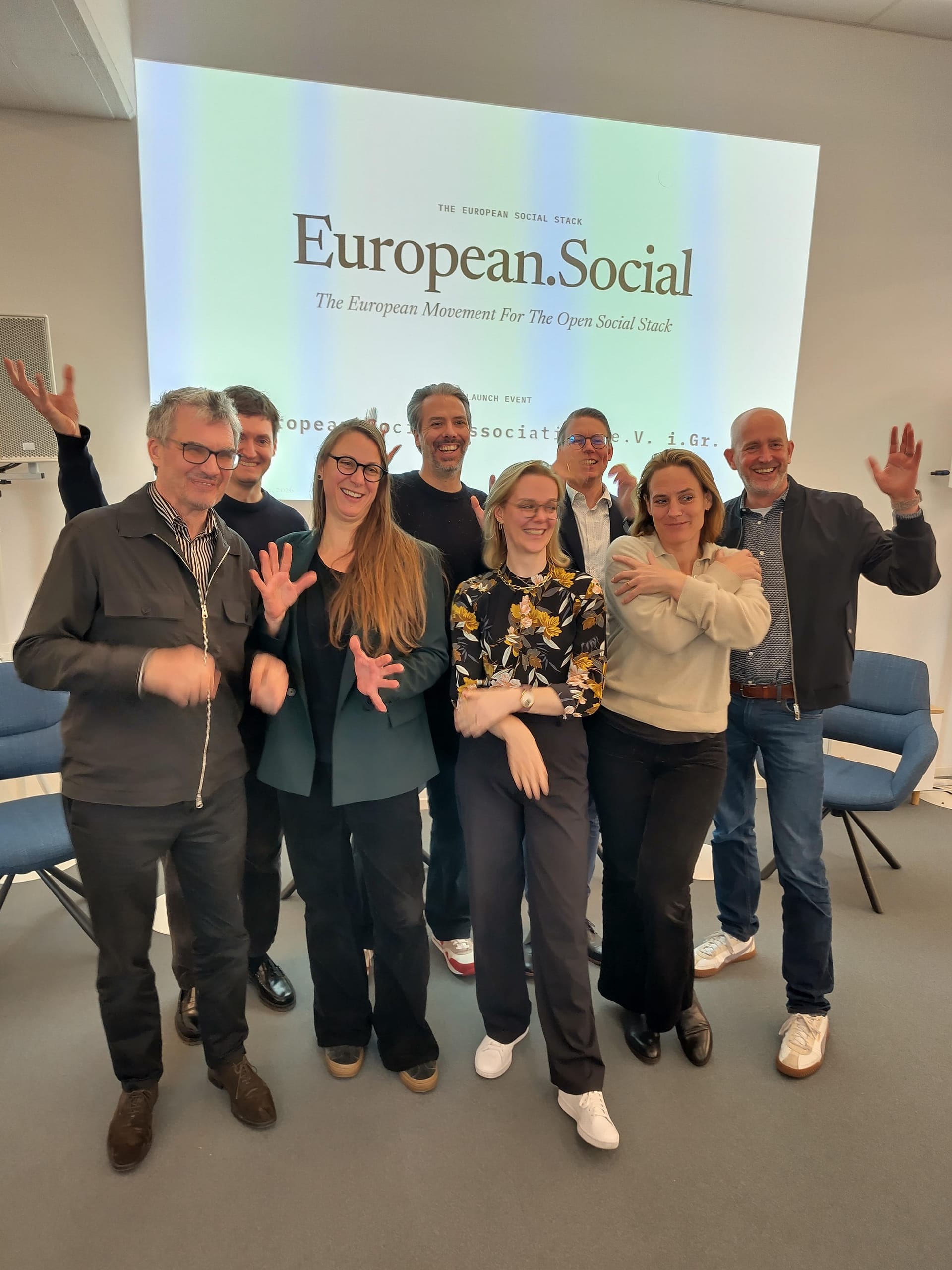
Today, at the European.Social launch in Berlin, people working on different parts of the Open Social Web came together around a common purpose. I left hopeful. I also left wanting to put one idea at the centre of the conversation:
Political communication is part of our public infrastructure. We should treat it as such.
The organisers rightly named democracy as the purpose from the start. I hope it remains central as the work progresses to protocols, interoperability and sustainable growth. These are the means; democracy is the end.
The conditions under which politicians speak, journalists report, communities organise and citizens meet one another are at stake. Currently, much of this relies on infrastructure controlled by a few Big Tech companies and their unaccountable leaders. These companies decide who gets heard, what becomes visible and which interactions are rewarded. Their incentives are not aligned with those of the public.
Building spaces for public life
Jantien Borsboom's contribution, and the work of PublicSpaces, made this point well: the places where we debate are something we build and maintain together.
We build parks, schools and transport systems because shared life needs shared infrastructure. The spaces where we exchange information, argue about political decisions and organise deserve the same long-term care.
As I learned from the open knowledge and Wikimedia movements, Wikipedia does not survive because its licence is open. It survives because people maintain it, govern it and pay for the servers behind one of the most visited sites in the world. Open protocols are a foundation, not a guarantee. Similarly, the Open Social Web will need accountable governance, real participation, and funding for those involved in building its infrastructure.
Who moves first: politicians and journalists
The point I raised at the event was the media. Journalism was already in the room: Björn Staschen is a journalist himself, and Save Social has the backing of German journalists' unions. What I'd like to see next is newsrooms, editors and public broadcasters joining as institutions, at the centre of this effort.
The day before, I met the two journalists behind WahlheYmat, who bring the voices of Berlin residents without voting rights into public debate. Their work asks whose voices are missing. I see a related question in building an Open Social Web: whose voices can be heard at all.
Much of the media still treats social platforms in terms of followers, reach and engagement. For newsrooms short on resources, those numbers matter. But they hide the dependency. When Meta blocked news in Canada in 2023, Canadian publishers lost, within weeks, an audience they had spent years building on someone else's land.
This is more than a business problem. Journalism is part of democracy's infrastructure too, and the platforms it relies on reward outrage over reporting and can bury news whenever their priorities change. So the questions newsrooms should be asking are different:
- Who controls access to our audience?
- What does our journalism give a platform by continuing to publish there?
- How can we help build spaces that support our democratic role?
These belong in editorial and organisational decisions, not only in audience reports. That is one more reason for newsrooms to have a voice in these discussions.
Still, I believe the most strategic step, and also the most challenging, is to persuade democratic representatives to leave platforms that are working to undermine democracy. I heard the argument that if journalists come, politicians will follow. I see it the other way round, and that is the core message of Leave X, Protect Democracy, the campaign I started in 2025: when politicians and political leaders move to the Open Social Web, media outlets will follow.
There are signs this is starting. In October, MP Anna Lührmann (Greens) spoke in the Bundestag about the Open Social Web Alliance, Mastodon and Eurosky, and invited the federal government to join the initiative. When she later asked Digital Minister Karsten Wildberger how the government would support the Open Social Web, he said that European platforms, Mastodon among them, were being examined, and that scaling them would be a focus of his ministry's work in the coming months. That is a commitment worth holding him to.
My focus here is on politicians and journalists, partly because politics is my own interest. Most people don't join social networks for politics. They come for friends, shared interests, art and local life. That is why the Open Social Web also needs to work for artists and small businesses, something I have written about before. The question is not only who should move, but how to make the Open Social Web a place people want to be.
Cooperation across protocols
The most promising thing about the launch was who shared the stage. Björn Staschen of Save Social and Michael Foster, co-founder of Newsmast, led the event, and Björn moderated a conversation with Sebastian Vogelsang of Eurosky and Felix Hlatky of Mastodon. Mastodon is the best-known service in the Fediverse, a network of independently run servers that talk to each other, much like email. Eurosky builds European infrastructure for the network behind Bluesky. Matrix, also discussed, does something similar for chat. They were presented as parts of one ecosystem, not as rivals. People have different communication needs, and a healthy public sphere has room for many services.
It was good to see Sander van der Waal again. We first worked together in the Open Knowledge Foundation network, and he is now strategy director at Waag. Many people building the Open Social Web today come from those earlier movements for open knowledge. And as Cathleen Berger of the Open Social Web Alliance put it, persuading institutions to change their habits takes patience.
Shared principles will give this cooperation direction when the hard decisions come: governance, funding, moderation and sustainable growth.
A European initiative with a wider horizon
Cathleen also noted that she saw no people of colour from the Global South in the room. Afterwards I introduced myself and thanked her for raising it. As a Brazilian living in Europe, I was glad someone did. My presence did not resolve the question.
The consequences of concentrated platform power reach far beyond Europe, and so does the experience of confronting it. Brazil is a case in point. In 2024 its Supreme Court suspended X nationwide for more than a month, after the company refused to name a legal representative in the country as Brazilian law requires.
Brazil also shows both the power of online organising and its fragility. Between the two rounds of last month's presidential election, a WhatsApp channel run by federal deputy André Janones grew from about 50,000 to nearly 11 million subscribers in three weeks, mobilising supporters of Lula's campaign. The channel was contested: the electoral court suspended it twice, and opponents accused it of spreading disinformation. At the same time, Lula's campaign accused Meta of favouring his opponent, which Meta denied. As James Görgen observes in Tech Policy Press, Meta was the stage, the defendant and the referee all at once. Racing to outpace a platform's algorithm is a survival tactic, not a democratic model. The Open Social Web could offer something better: reach that doesn't depend on gaming someone else's rules.
I was glad to see the Brazilian organisation Alquimídia among the initiative's supporters. European.Social is rightly a European effort, and it is good to see Europe taking the lead. As it grows, I hope it will build bridges with people and organisations from the Global South, who have much to contribute.
A promising start, and what comes next
Politicians bring audiences and institutional authority. Journalists bring visibility and hold power to account. Civil society brings experience in defending rights, and often builds what neither markets nor governments provide. Communities and people bring the relationships that give these spaces meaning. Companies, too, can help fund this infrastructure, if they commit to its guiding principles. All of them are needed to change a system that turns our attention into revenue and rewards hostility and division.
Three things would help it build on that start:
- Win over democratic representatives, and bring newsrooms and public broadcasters inside, as partners shaping the work, not only as accounts to migrate.
- Build bridges beyond Europe, learning from and working with people and initiatives in the Global South as the work grows.
- Fund maintenance, moderation and resilience, so that growth is sustainable.
The first is the hardest. The second needs something funding alone cannot provide: a more open vision of who the social web is for, and who gets to shape it. The third keeps everything running, but it needs care: who pays shapes what gets built.
I want this initiative to succeed. If democracy and dialogue stay its guiding purpose, and decision makers join the conversation, it can.
If you care about the infrastructure of our political communication, read and sign the European.Social declaration.